
Lost In Marketing? Here's The Complete Digital Marketing Framework You Need
You know that feeling when you're bouncing between Instagram one day, Google Ads the next, then firing off a random email blast on Friday? That's not marketing. That's chaos dressed up as hustle.
Most business owners try to "do marketing" like they're checking off a to-do list. Did I post today? Check. Did I run an ad? Check. Did I send that email? Check.
But here's the truth: real growth doesn't come from checking boxes. It comes from building a system where every piece actually works together instead of fighting for attention in your already-overwhelmed brain.
And that's exactly what a complete digital marketing framework gives you. It's not just a collection of tactics you heard about from some guru. It's a structured blueprint that organizes your marketing channels, tactics, and metrics into a cohesive system designed to achieve specific business goals.
Let me explain why this matters so much.
Why Most Marketing Strategies Fail (And It's Not Your Fault)
The truth is, most businesses fail at digital marketing because they treat it like a random checklist of activities. "Should I post on Instagram? Should I run Facebook ads? What's the best email tool?" Sound familiar?
But when you only focus on one channel at a time, you're leaving 70% of your opportunity on the table. That's not an exaggeration. That's what happens when your marketing efforts aren't connected.
Research shows that implementing a digital marketing strategy framework is essential to the success of an integrated marketing strategy. Without it, you end up with what I call "tool chaos." Your SEO team doesn't talk to your content team. Your paid media specialists operate in a vacuum, completely separate from your email marketers.
And from the customer's perspective? They see one message in your Facebook ad, read something totally different on your blog, and then get an email that feels like it came from another company entirely. This erodes trust and seriously weakens your brand.
Good luck getting anywhere with that approach.
The Complete Digital Marketing Framework: How All The Pieces Fit Together
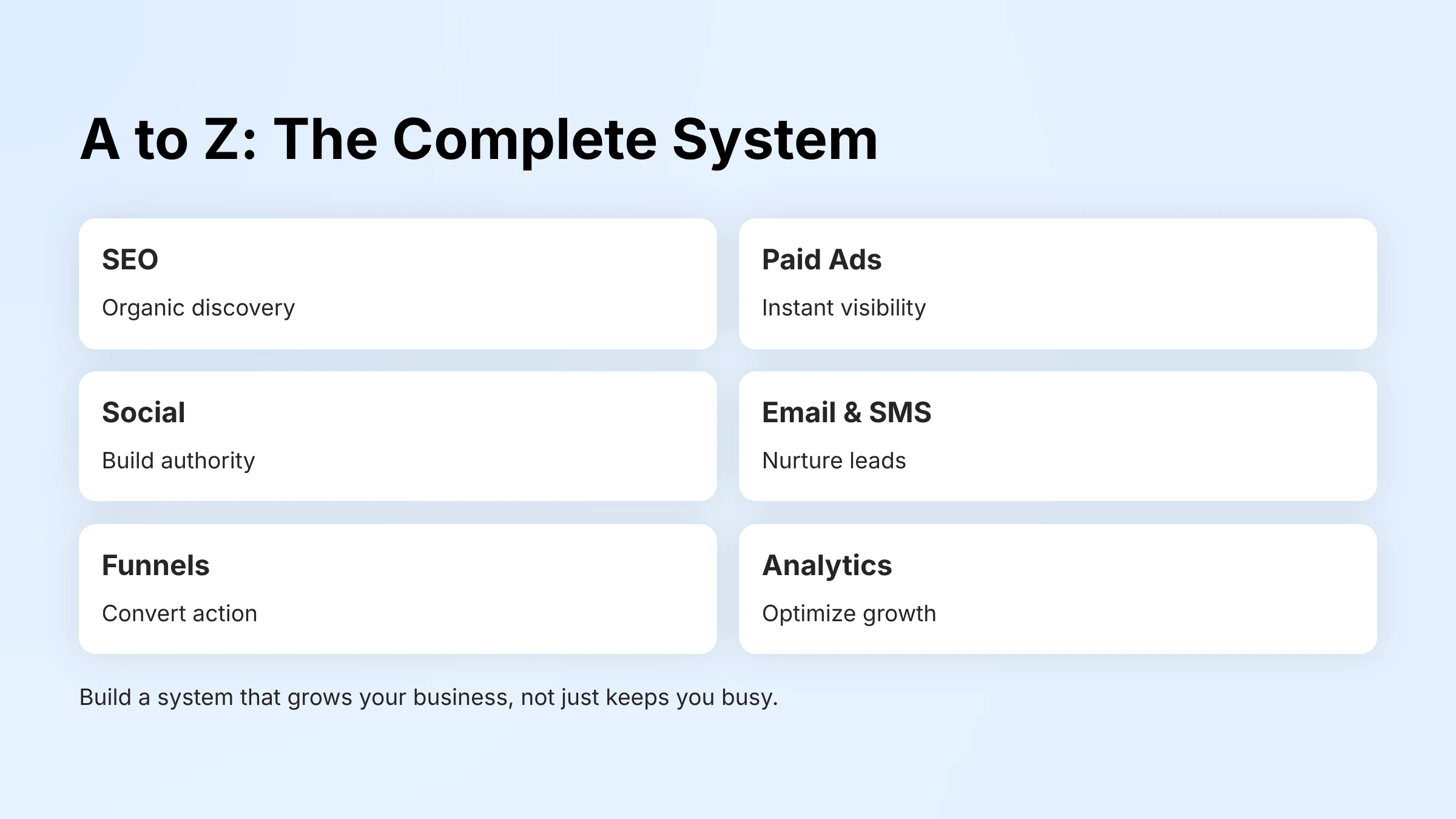
Let me break down the core channels and what each one actually does. Because here's the thing: if you don't understand what each channel is designed for (and what it's NOT), you'll keep wasting time and money.
SEO: The Always-On Traffic Machine
This is about capturing people who are already searching for what you offer. And don't get me wrong, it's not just Google anymore. YouTube, TikTok, even AI tools like ChatGPT are search engines now. If you're not showing up where people search, you're invisible.
Paid Ads: The Fast Lane
The fastest way to get in front of buyers. Search ads capture people with intent ("emergency plumber near me"). Social ads generate demand and build awareness. The key is matching your ad to the stage of the customer journey. Run awareness ads to people who've never heard of you. Run conversion ads to people who are ready to buy.
Social Media: The Trust Builder
It's not about going viral (though that's cool and all, but not that useful for most businesses). It's about being present where your audience hangs out, sharing value, and starting conversations. Social builds trust, authority, and community over time.
Funnels: The Conversion Path
Lead magnets, landing pages, nurture sequences. These are the steps that move people from "just looking" to "take my money." A good funnel removes friction at every stage and makes buying feel like the obvious next step.
Email & SMS: The Follow-Up Engine
Most sales happen after 5+ touches. If you're not following up, you're leaving money on the table. Email and SMS let you nurture, educate, and close automatically. No manual work required once you set it up right.
Analytics: Your Business Dashboard
If you're not measuring, you're guessing. Analytics show you what's working, what's not, and where to double down. The digital marketing framework gives you a way to assign specific metrics to monitor, manage and measure performance.
The Flywheel Effect: Why Systems Beat Tactics Every Single Time
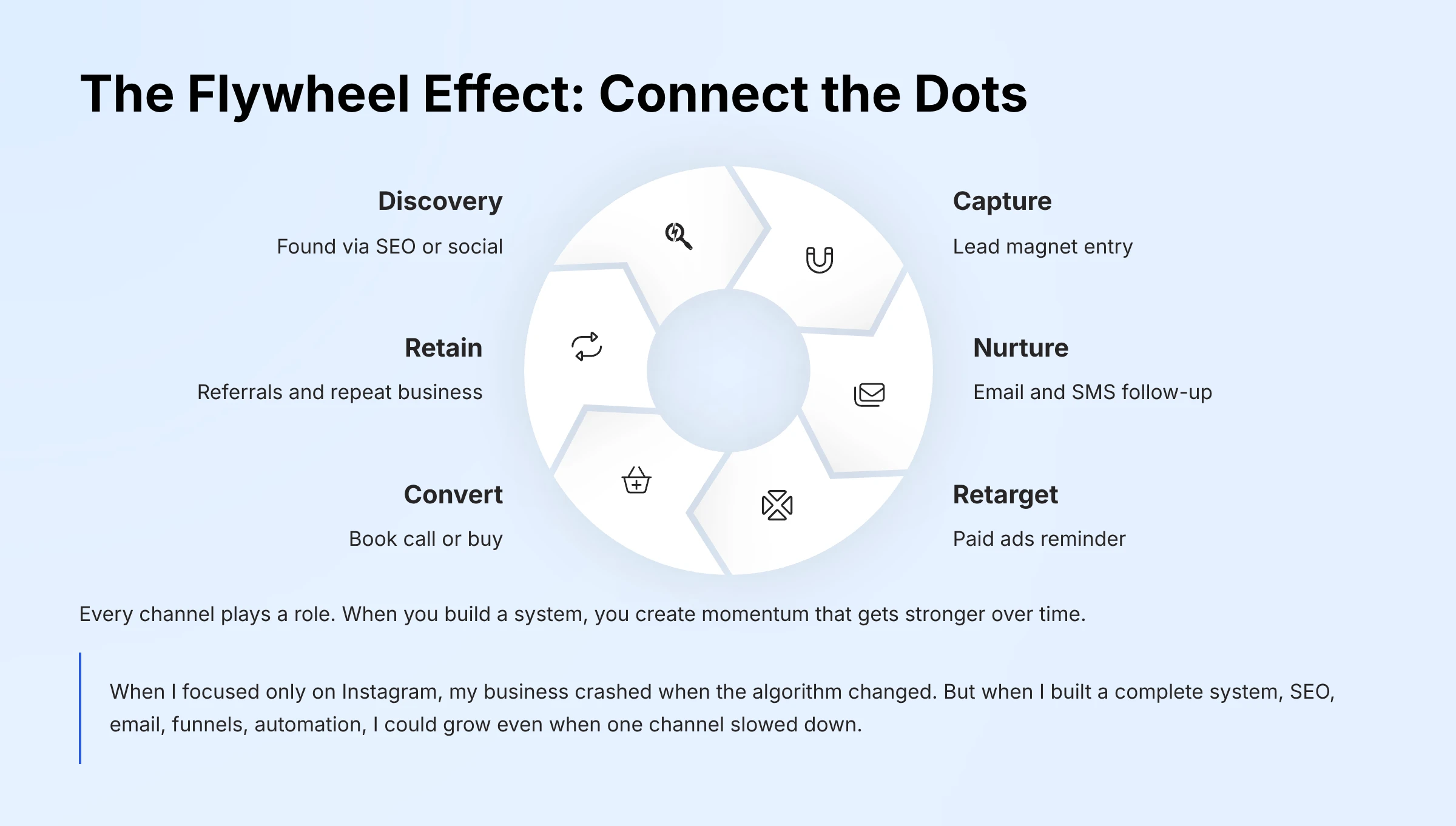
Here's where it gets interesting. When you connect all these channels properly, you don't just add them together. You multiply them.
The flywheel effect is a concept from physics that has been adapted into business strategy. It describes how companies achieve sustainable growth by focusing on continuous, compounding efforts rather than one-off campaigns.
Think of a massive, heavy wheel. At first, pushing it takes enormous effort. But as you keep pushing consistently, it starts to move. Eventually, the weight of the flywheel works in your favor, and it spins on its own with minimal effort. Each turn of the flywheel builds upon work done earlier, compounding your investment of effort.
Here's how it works in practice:
Someone finds you through SEO or a social post. They click your lead magnet and enter your funnel. They get nurtured by email and SMS. Maybe they see a retargeting ad reminding them you exist. Eventually, they book a call or buy. After the sale, you keep nurturing them for referrals and repeat business.
Every channel plays a role. And when one channel succeeds, it makes the others stronger. That's the magic of building an integrated digital marketing strategy instead of just running disconnected tactics.
For example, when I launched my first real business, I focused only on Instagram. It worked... until it didn't. When the algorithm changed, my business crashed overnight. I had no backup. No system. Just one tactic that I rode until it stopped working.
But when I built a complete framework (SEO, email, funnels, automation), I could grow even when one channel slowed down. That's the power of an integrated approach.
Why Your Marketing Feels Like Duct-Tape And Random Guesses
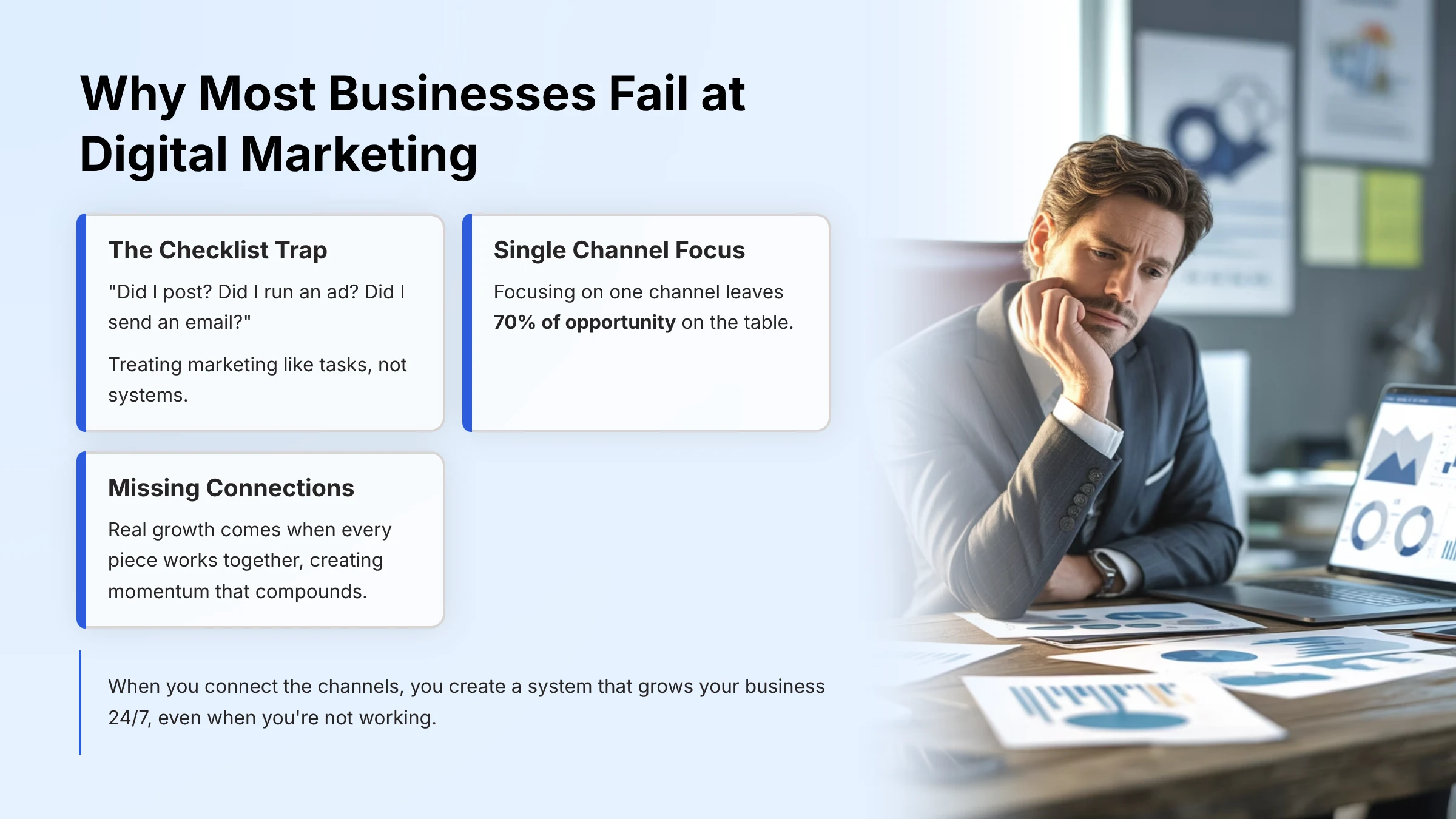
Let's be honest about what's probably happening in your business right now.
You're using Google Sheets to track leads. Email for client communication. Maybe Slack or Teams for internal stuff. A project management tool that doesn't connect to anything else. A CRM that stands alone. Landing page builders that don't feed leads into your system. Analytics spread across multiple platforms.
Sound about right?
The problem isn't that these tools are bad. The problem is they don't talk to each other. You're spending hours copying data between systems, losing information, missing follow-ups, and wondering why nothing seems to work smoothly.
Research shows that businesses waste an average of 26% of their marketing budgets on ineffective channels and strategies because they lack an integrated framework. Some waste as much as 60% because of tool chaos and disconnected systems.
That's not just money. That's your time. Your sanity. Your ability to actually grow instead of just staying afloat.
How To Build Your Digital Marketing Framework (The Right Way)
Alright, let's get practical. You can't just wave a magic wand and suddenly have a perfect system. But you can start building one today.
Step 1: Map Your Current Reality
What are you actually doing right now? Write down every marketing activity. Every tool you're using. Every channel you're active on. Be honest. No judgment.
Step 2: Understand Your Customer Journey
How do people find you? What steps do they take before buying? Where do you lose them? According to the RACE framework, you need to track Reach (how they find you), Act (their first interaction), Convert (when they buy), and Engage (how you keep them).
Step 3: Connect The Dots
This is where most people fail. They have all the pieces but they're not connected. Your SEO needs to feed into your email list. Your social media needs to drive people to your funnels. Your analytics need to show you what's actually working.
Step 4: Consolidate Your Tools
You don't need 20 different platforms. You need 5-7 core tools that actually talk to each other. The most successful companies use consolidated platforms that reduce complexity while improving performance.
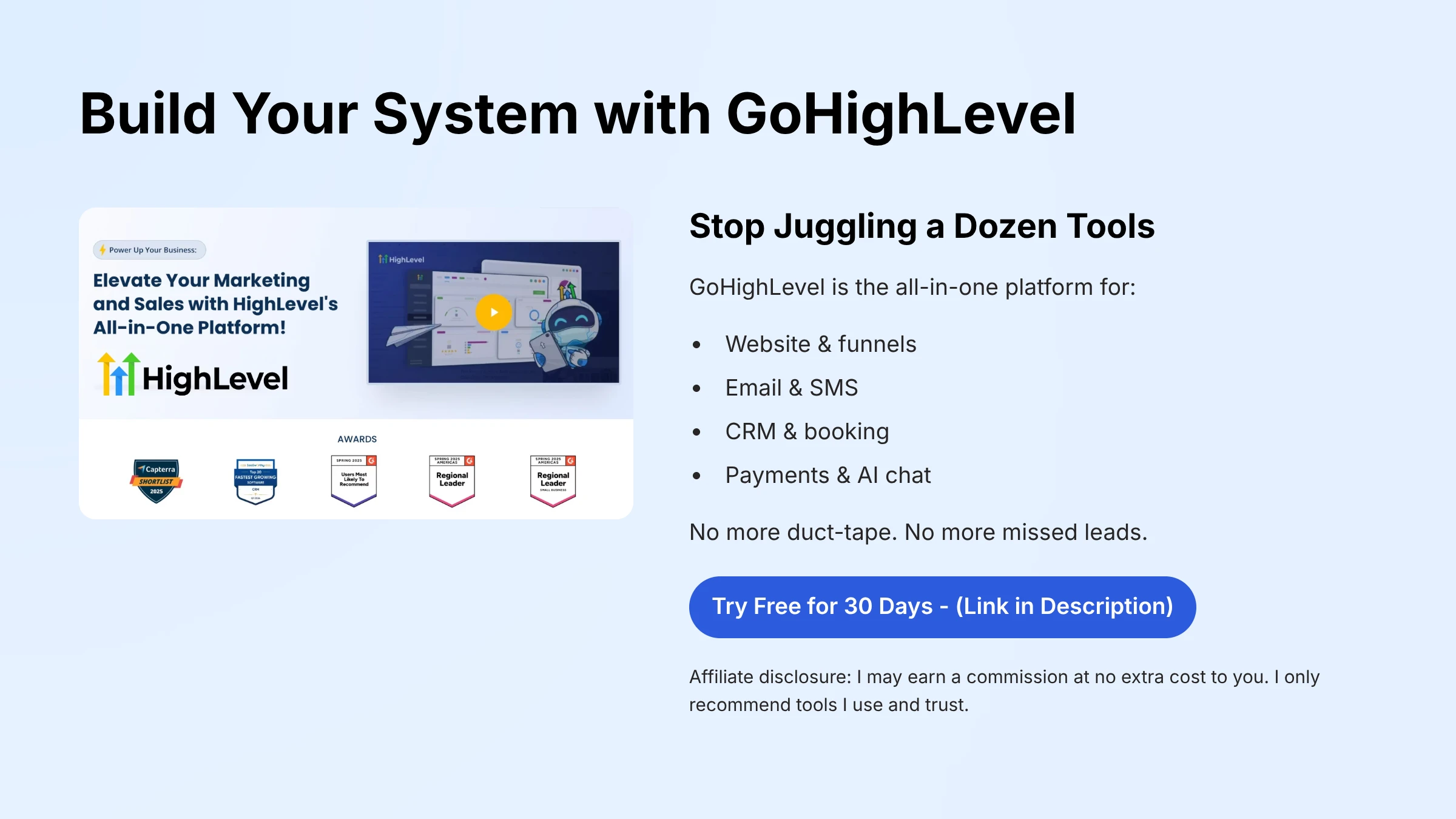
This is exactly why I run my entire business on GoHighLevel. Website, funnels, CRM, email, SMS, booking, payments, and even AI-powered chat and voice, all in one place. No duct tape. No missed leads. No manual copying between systems.
Try it free for 30 days using my link, and you'll unlock over $7,000 in bonuses including my Smart AI Website Training and private community access. (Full disclosure: I'm an affiliate, so I may earn a commission if you sign up, but I only promote what I actually use every single day.) All the details are at the link.
Step 5: Start Small, Build Momentum
Don't try to fix everything at once. Pick one weak link in your system and make it stronger. Maybe it's your email follow-up. Maybe it's your funnel conversion rate. Maybe it's just getting your analytics set up properly.
The flywheel effect teaches us that small, consistent improvements compound over time. You don't need massive changes. You need the right changes in the right order.
The Compound Effect: Why This Gets Easier Over Time
Here's the part most marketing gurus won't tell you: building a framework is hard at first. It takes effort. It takes focus. It takes saying no to shiny objects and staying committed to your system.
But once you get that flywheel spinning? It gets easier. Each new customer becomes a referral source. Each piece of content compounds with your SEO. Each email in your nurture sequence works 24/7 without you touching it.
Companies like Amazon have built their entire business model on the flywheel effect. Better customer experience leads to more traffic. More traffic attracts more sellers. More sellers mean better selection and lower prices. Better selection and lower prices create an even better customer experience.
That's not luck. That's a system designed to compound.
And you can build the same thing for your business, regardless of size. The principles don't change whether you're a solopreneur or running a team of 50.
What To Do Next (No More Random Tactics)
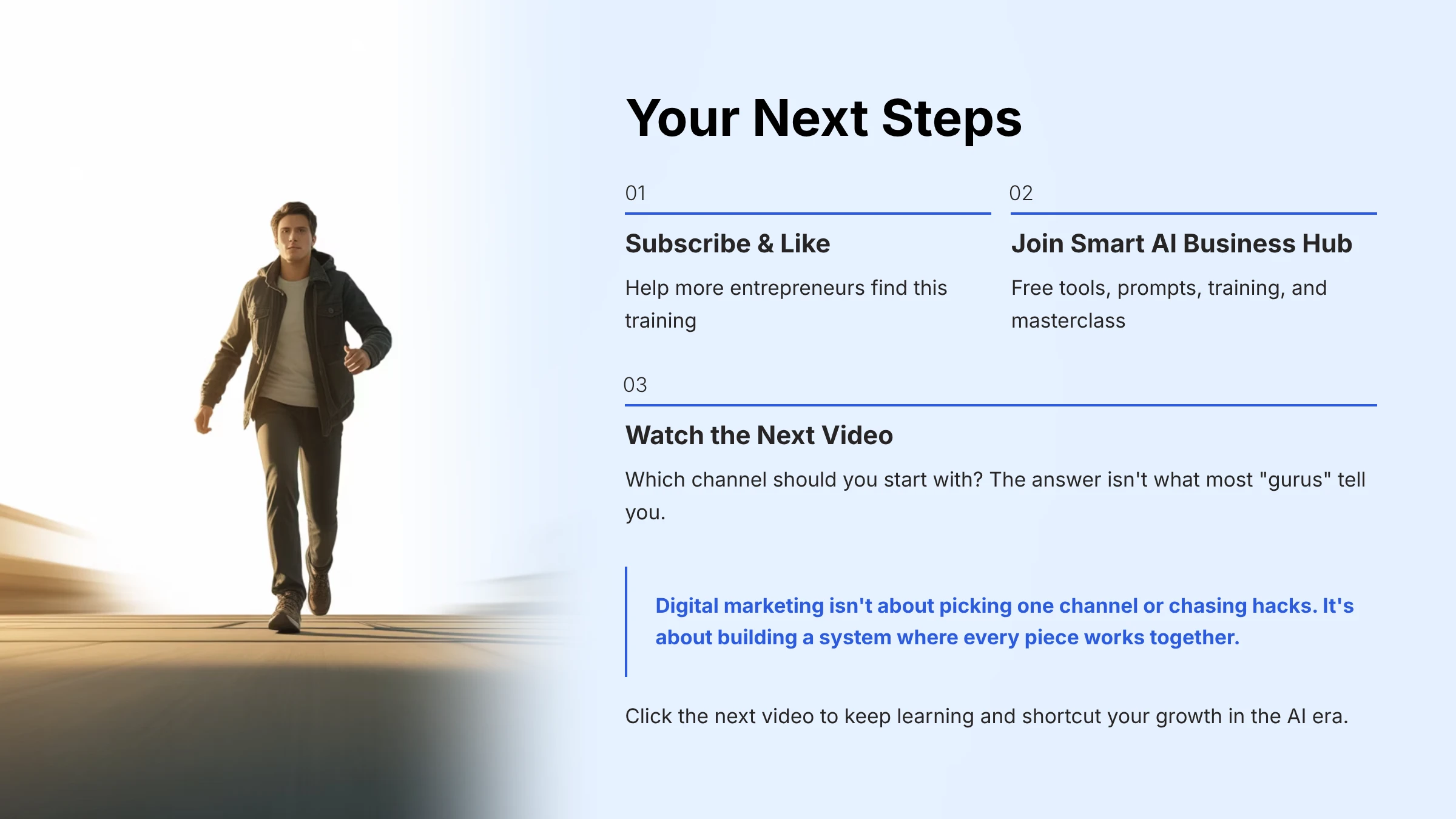
Stop treating marketing like a checklist. Stop chasing the latest hack or trend. Stop juggling a dozen disconnected tools and hoping something works.
Instead, build a framework. Connect your channels. Create a system that actually works together.
Here's how to start:
First, join my free Smart AI Business Hub. It's our private community for entrepreneurs and business owners, packed with tested tools, practical tutorials, and a network of people actually growing in the AI era. You'll get access to copy-paste prompts, implementation templates, and the full training series.
Second, if you're serious about consolidating your tools and building a real system, check out GoHighLevel's 30-day free trial. It's the all-in-one platform that eliminated my tool chaos and let me focus on growth instead of duct-taping systems together.
Third, watch the rest of this video series. Because knowing you need a framework is step one. Understanding which channel to start with based on your specific business? That's the next piece. And it's not what most gurus tell you.
The truth is, digital marketing isn't about picking one channel or chasing the latest growth hack. It's about building a system where every piece works together, SEO, ads, social, funnels, email, analytics. When you connect the dots properly, you create momentum that compounds over time.
You create a business that grows while you sleep, serves while you scale, and thrives even when individual tactics or platforms change.
That's what a complete digital marketing framework gives you. Not more work. More results with less stress.
Now go build your system.
Copyright © OnlineMarketer.ai – All rights reserved.
DISCLAIMER:
This blog is for educational and entertainment purposes only. It does not constitute business, legal, financial, or investment advice, and should not be interpreted as such. The views and opinions expressed are based on publicly available information and are intended to spark critical thinking and informed decision-making.
OnlineMarketer.ai does not guarantee the accuracy, completeness, or timeliness of any information presented. Always consult a qualified professional before making any decisions related to business, marketing, or technology.
FAIR USE NOTICE:
Some content used in this blog may include copyrighted material for the purpose of commentary, criticism, news reporting, teaching, or education - all of which falls under Section 107 of the Copyright Act as “fair use.” No copyright infringement is intended.
If you are the copyright owner of any material used and have concerns about its use, please email [email protected] and we’ll resolve it promptly.
AFFILIATE DISCLOSURE:
Some of the links in this blog may be affiliate links. This means I may earn a small commission - at no extra cost to you - if you decide to purchase through those links. I only promote tools and platforms I personally use and believe in.


